Major, Minor, and Exotic Currency Pairs: A Practical Guide
Created at: 2026-03-26 | Category: FX

Every movement in the foreign exchange market starts with a currency pair.
Whether traders are reacting to central bank decisions, inflation data, or shifts in global risk appetite, all FX trades are ultimately expressed through the price relationship between two currencies.
Understanding how currency pairs work and why some behave very differently from others is essential for anyone navigating the FX market.
This matters even more considering the scale of the market. According to the Bank for International Settlements (BIS), average turnover in the global foreign exchange market reached US$9.6 trillion in April 2025 per day, making FX the largest and most liquid financial market in the world.
That liquidity is not evenly distributed, and this is where the distinction between major, minor, and exotic currency pairs becomes critical.
In this guide, we break down:
- What a currency pair really represents;
- How FX prices are quoted and traded;
- The key differences between major, minor, and exotic pairs;
- Why certain pairs move faster, cost more, or react sharply to news.
What Is a Currency Pair?
A currency pair shows the value of one currency relative to another.
In FX, currencies are always traded in pairs because one currency is exchanged for another. For example:
- EUR/USD compares the euro to the U.S. dollar.
When the price rises, the euro is strengthening against the dollar.
When the price falls, the euro is weakening.
You can think of it like an exchange rate at an airport, except in FX, that rate never stops moving. It updates continuously as markets around the world digest new data, policy signals, and shifts in sentiment.
Each currency in a pair is identified by a standardised three-letter code defined by the International Organization for Standardization.
The first two letters typically represent the country of origin, while the third represents the currency itself. For example, USD stands for the United States Dollar, GBP for the Great British Pound, and JPY for the Japanese Yen.
How Currency Pairs Are Quoted
Every currency pair is divided into two parts:
Base currency
Quote currency
The price tells you how much of the quote currency is needed to equal one unit of the base currency.
Example: If EUR/USD is quoted at 1.1450, it means one euro is worth 1.1450 U.S. dollars.
The convention for which currency appears first in a pair follows a widely accepted priority ranking. As established by the European Central Bank upon the euro's launch in 1999, the euro holds first precedence as a base currency.
As a result, any currency pair that includes the euro will place it in the base position (e.g., EUR/USD, EUR/GBP, EUR/JPY).
On the Excent Capital trading platform, you will always see two prices:
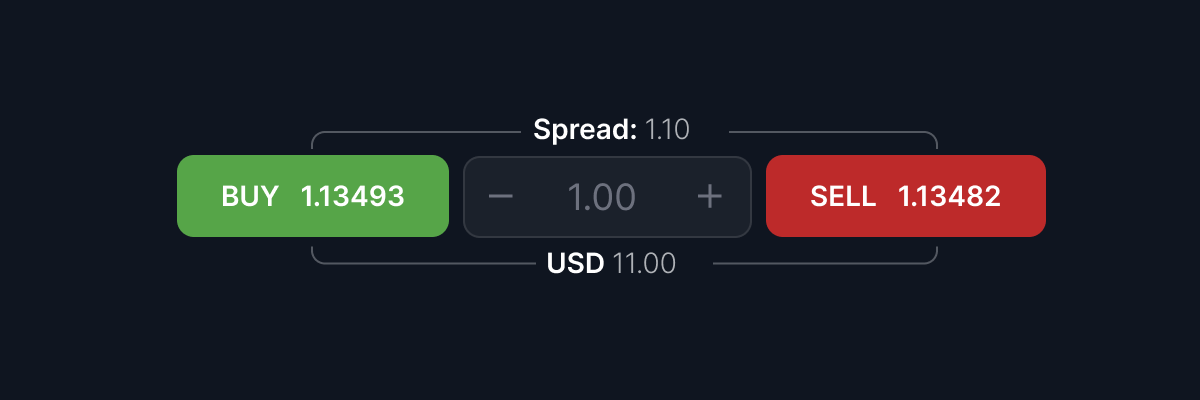
- Bid: the price at which the market buys;
- Ask: the price at which the market sells.
The difference between those two prices is called spread, which represents the cost of opening that specific position. Tighter spreads generally mean lower trading costs, and they are most commonly found in highly liquid pairs.
Buying and Selling a Currency Pair
This is where it is important to understand that every FX trade is a two-sided transaction. You are always buying one currency and selling another at the same time.
Going long (buying a pair): When you buy EUR/USD, you are buying euros and selling U.S. dollars. You do this if you speculate the euro will strengthen relative to the dollar, meaning the price of the pair will rise.
Going short (selling a pair): When you sell EUR/USD, you are selling euros and buying U.S. dollars. You do this if you speculate the euro will weaken against the dollar, meaning the price of the pair will fall.
Think of a currency pair as a tug of war between two economies. Each side pulls based on factors like interest rates, economic data, political stability, and global risk sentiment. Your job as a trader is to assess which side has more strength at any given moment.
Practical example: Suppose the European Central Bank signals a rate hike while the U.S. Federal Reserve holds steady. In that scenario, the euro may strengthen against the dollar, and a trader expecting this outcome would go long on EUR/USD.
Types of Currency Pairs: Why Are They Grouped
Not all currency pairs behave the same way, and they are not grouped randomly.
Currency pairs are divided into major, minor, and exotic groups based on how much they are traded, how easy they are to buy and sell, and how important the currencies are in the global economy.
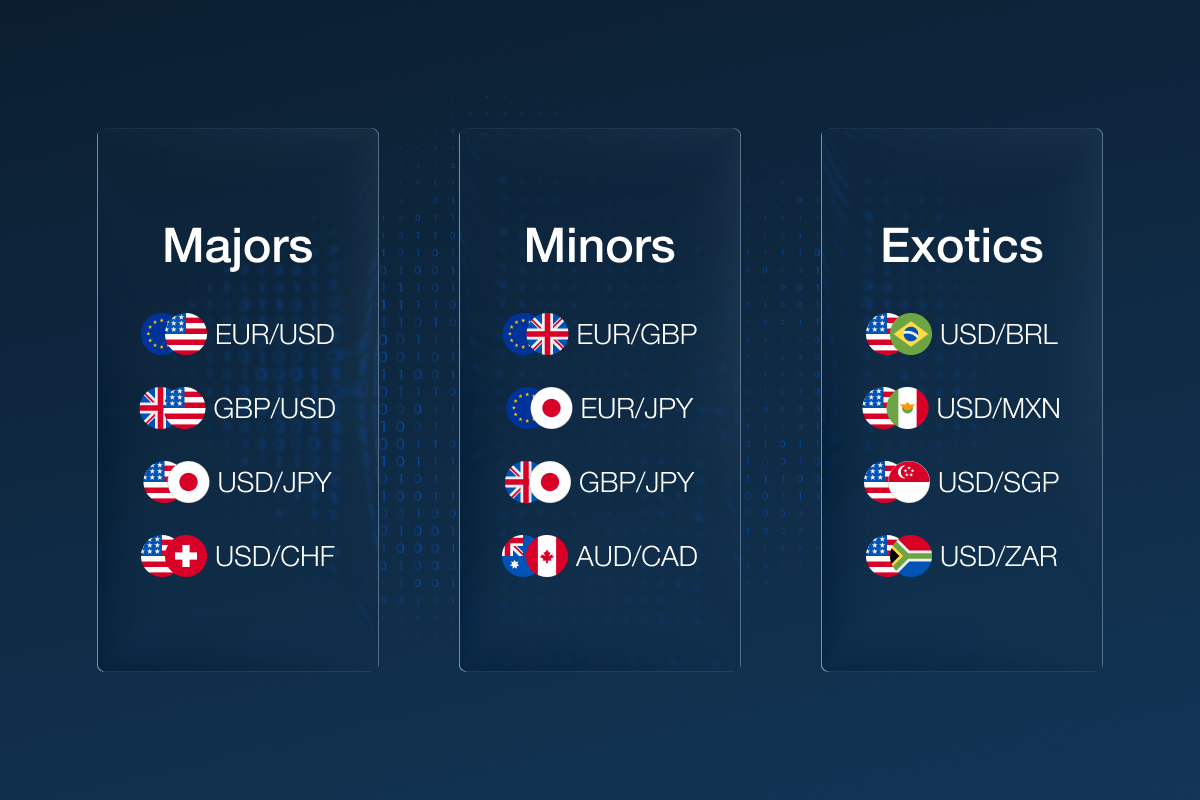
This classification matters because it is what defines the cost of entering a position, the speed of execution, the stability of price action, and what type of analysis that tends to be most effective.
To put in perspective, the U.S. dollar alone appears on one side of 89.2% of all FX trades, according to the BIS 2025 Triennial Survey.
That concentration of activity is a major reason why USD-based pairs dominate global liquidity and why the distinction between pair categories exists in the first place.
Highly traded major pairs attract continuous participation from institutions, central banks, and retail traders around the clock. This depth of activity means tighter spreads, faster order execution, and more orderly price movements.
Less traded exotic pairs present a different environment. With fewer participants, there are fewer buyers and sellers available at any given moment.
This means trading costs tend to be higher and prices can move more sharply and unpredictably, particularly around local news events or during off-peak trading sessions.
Major Currency Pairs and Why They Dominate FX Volume
Major currency pairs are the most traded pairs in the global FX market. They all share one key characteristic: they always include the U.S. dollar on one side.
The reason is straightforward. The U.S. dollar is the backbone of the global financial system. According to the International Monetary Fund, the dollar accounted for approximately 57% of global official foreign exchange reserves as of Q3 2025.
There are the seven major currency pairs:
| Pair | Name |
|---|---|
| EUR/USD | Euro / U.S. Dollar |
| USD/JPY | U.S. Dollar / Japanese Yen |
| GBP/USD | British Pound / U.S. Dollar |
| USD/CHF | U.S. Dollar / Swiss Franc |
| AUD/USD | Australian Dollar / U.S. Dollar |
| USD/CAD | U.S. Dollar / Canadian Dollar |
| NZD/USD | New Zealand Dollar / U.S. Dollar |
EUR/USD is the most traded currency pair globally, representing over one-fifth of total FX turnover. It is followed by USD/JPY and GBP/USD, which together make up a significant share of global trading activity.
Major pairs dominate global FX volume for good reason:
- High liquidity: Because they are traded so frequently and in such large volume, major pairs tend to have the tightest spreads and most efficient execution.
- Lower trading costs: Tighter spreads allow traders to retain more of their returns on each position. This cost efficiency can make a meaningful difference in performance.
- More predictable price action: Major pairs respond to macroeconomic news, central bank policies, and widely followed economic indicators, making both technical and fundamental analysis easier to apply.
- Deep market participation: Institutional traders, central banks, hedge funds, and retail traders all participate in major pairs, creating continuous market depth across all trading sessions.
For beginners, the major pairs offer the best learning opportunity: tight spreads, a wide range of educational resources, and price behaviour driven by data you can track and study.
Minor Currency Pairs: Trading Without the U.S. Dollar
Minor currency pairs, often called cross pairs or simply crosses, are pairs that do not include the U.S. dollar. Instead, they combine two other major currencies.
Historically, if you wanted to exchange, say, euros for Japanese yen, you would first have to convert EUR to USD and then USD to JPY. Cross pairs were created to streamline this, allowing direct trading between non-USD currencies.
The most commonly traded minor pairs involve the euro, the British pound, or the Japanese yen on at least one side.
Examples of popular minor currency pairs:
| Pair | Currencies |
|---|---|
| EUR/GBP | Euro / British Pound |
| EUR/JPY | Euro / Japanese Yen |
| GBP/JPY | British Pound / Japanese Yen |
| EUR/AUD | Euro / Australian Dollar |
| GBP/CAD | British Pound / Canadian Dollar |
| AUD/JPY | Australian Dollar / Japanese Yen |
| CHF/JPY | Swiss Franc / Japanese Yen |
Minor pairs offer a way to trade the relative strength between two non-USD economies directly.
Minor pairs are a natural next step for traders who already understand how the majors behave and want to diversify their exposure or express more specific economic views.
Exotic Currency Pairs: High Volatility, New Opportunities
Exotic currency pairs combine one major currency with the currency of an emerging or smaller economy. They are called exotic because they sit outside the mainstream of global FX liquidity.
Trading activity in exotic pairs has been growing steadily.
According to a World Economic Forum analysis of the latest global FX data, currencies from emerging economies have been gaining market share as these nations expand their role in international trade and investment. The Chinese renminbi, for instance, rose to 8.5% of global FX turnover.
Examples of exotic pairs:
| Pair | Currencies |
|---|---|
| USD/ZAR | U.S. Dollar / South African Rand |
| USD/MXN | U.S. Dollar / Mexican Peso |
| USD/SGD | U.S. Dollar / Singapore Dollar |
| EUR/PLN | Euro / Polish Zloty |
| USD/BRL | U.S. Dollar / Brazilian Real |
Exotic pairs commonly attract a specific profile of trader.
Usually, these are more experienced investors with direct knowledge of a particular region's economy, monetary policy, or commodity dynamics.
Some also use exotic pairs for carry trade strategies, where the goal is to capture the interest rate differential between the two currencies over time.
What Moves Currency Pairs?
Understanding what drives the price of a currency pair is just as important as knowing how it is structured. In many ways, it is what separates theory from practice.
These drivers do not operate in isolation. On any given day, interest rate expectations, economic data, and geopolitical headlines can all push the same pair in different directions at once.
Reading and analysing how these forces interact is where real market understanding begins.
Several key factors consistently influence FX rates across all categories of pairs:
Interest rates and central bank policy:
Central banks such as the U.S. Federal Reserve, the European Central Bank, or the Bank of Japan set benchmark interest rates that directly affect currency demand.
Higher interest rates tend to attract capital inflows and strengthen a currency, while rate cuts can weaken it.
Economic data releases:
Reports on economic growth (GDP), employment, inflation, retail sales, and manufacturing output give traders insight into the health of an economy.
Stronger-than-expected data tends to support the domestic currency while weaker data puts it under pressure.
You can follow all of these releases and more through the Excent Capital Economic Calendar, which tracks key global data events in real time.
Geopolitical events:
Elections, trade agreements, sanctions, military conflicts, and shifts in diplomatic relations can all cause rapid and sometimes sharp movements in currency pairs, particularly exotics.
Risk sentiment:
In times of global uncertainty, capital tends to flow toward safe-haven currencies like the U.S. dollar or the Swiss franc. When confidence returns, money flows back into growth-oriented or emerging market currencies.
Commodity prices:
Some currencies are closely tied to the performance of specific commodities because their national economies depend heavily on exporting them.
Currencies of commodity-exporting nations, like Canada, Australia, or Brazil are often influenced by movements in global commodity prices.
How to Choose the Right Currency Pair
At the end of the day, there is no single “best” currency pair. The right choice depends on your experience level, trading style, risk tolerance, and how much time you spend following economic data or market news.
Here are some considerations you can use before starting:
Lower experience level: Many traders begin by focusing on one or two major pairs, such as EUR/USD or GBP/USD, because of their high liquidity, tighter spreads, and the wider availability of educational content.
These pairs tend to respond to well-documented economic events, which can make them easier to study and follow.
Growing experience: As familiarity with the market increases, some traders explore minor pairs like EUR/GBP, EUR/JPY, or AUD/JPY.
They reflect specific cross-economy dynamics and do not involve direct USD exposure, which can offer a different perspective on global currency movements.
More experienced traders: Exotic pairs may attract traders who have a deeper understanding of specific regional economies or who are comfortable navigating wider spreads and less predictable price behaviour.
They require a higher level of awareness of local economic and political conditions.
Regardless of experience level, many traders find that concentrating on a smaller number of pairs allows for a deeper understanding of how those pairs behave across different sessions, news events, and market conditions.
Start Trading Currency Pairs with Excent Capital
Whether you are focused on majors, exploring minors, or monitoring exotics, the differences in liquidity and volatility will shape your trading experience.
At Excent Capital, you get access to a wide range of currency pairs with transparent pricing, ultra-low spreads, no slippage under normal market conditions, and instant execution.
Combined with our educational resources and daily trading ideas through Analysis IQ, you have everything you need to trade with confidence in one place.
Open your account today and start exploring the FX market with Excent Capital.